


In a coaching clinic, Maestro Gil Pezza equated Fencing distance to that of an accordion, contracting as the fencers gain proximity to one another and expanding as they withdraw and create space. Visually, this is perhaps the most accurate analogy I’ve come across.
In the single tempo modern Epee game that has gotten to much tighter distances forced by the urgency of P-Cards, I see distance in Epee as a game of push and pull, with one fencer exerting pressure (push), and the other receiving the pressure (pull). Picture if you will, two fencers of equal height and handedness, one on the push, the other on the pull. In proper distance, these fencers are “beyond the direct reach of the opponent while being close enough that you can easily threaten your opponent with your point without having to get too close” (Schrepfer, 2015).
The pushing and pulling fencer’s tactics boil down to three basic ideas:
- They can enter distance and attack
- They can sucker the opponent into their distance and attack in prep
- They can bait the opponent’s attack out and respond

Going through writings on fencing dating back to the 1500’s and looking even into the present day, I haven’t found any ideas that holistically capture fencing distance, and thus, I have opted to create a Frankensteinian bastardization of the works of Joachim Meyer and Maestro Frederic Fenoul.
In Joachim Meyer’s 1570 treatises on Fencing, Meyer articulated a concept that in my opinion is still wholly relevant in the present. Meyer effectively stated that there are two distances to be cognizant of:
- Zufechten (The Onset) – The provoking distance or as Meyer said “…the distance from the opponent at which acting in before provokes an opponent to respond in order to achieve a position of strength, such as is optimal,” and;
- Krief (The War) – “the distance from the opponent at which it is possible to land a hitter.[1]”
In the present, Maestro Frederic Fenoul articulates a concept called a “War for Territory,” in which the main task of the fencer is to “…control the distance between his opponent and himself to be able to realize the action corresponding to that distance,” and to “choose the proper action regarding the distance when he is not able to impose the distance.” And perhaps most notably, Fenoul calls out the idea of choosing “the depth at which he lets his opponent enter and selects the action accordingly.”
Thus, in addition to Meyer’s distances is Fenoul’s idea of how much distance you intentionally cede to the opponent to let them enter and set yourself up for a successful touch.
To understand how we got to our modern epee distance, it’s important to look into the past and see the events, rules, and ideas that brought us to the present.
A (Very) Short and Incomplete History of Distance in Epee Fencing and the Rules that Changed the Game
USA Fencing Hall of Famer Andrey Geva, Geva suggested that the game of Epee is cyclical and changes in style and tactics every 5-6 years.
Observing the sport over the years, it seems that the most variable factor in Epee is distance, and distance seems to be predicated on rule changes.
Long before the days of Non-Combativity, Unwillingness to Fight, or whatever you want to call it, Epee was hardly a game of urgency, but one of strategic patience, cat and mouse, and baiting. It was commonplace to see a 15-touch bout end 1-0 in priority. And to the FIE/IOC, this became a problem. We’ll get to that.
While hardly a representative sample size, I combed through some classic bouts going back to the 1984 Olympics and there was a common thread: the typical “Zufechten” distance between the fencers was farther away and the fencers seemed far more comfortable operating at two tempos away. Observationally, there seemed to be more of a reliance on the blade, stronger focus on defense and second intention, footwork occurring more with full advances/full retreats, and an emphasis on forcing the opponent to make mistakes rather than being proactive.
In the 1980’s, three major revolutions to the rules and meta occurred:
- Direct Eliminations (DE’s) shifted to 10 touches where you had to win by 2 points within 12 minutes, and if the score tied, the clock turned off, doubles were ignored and the next single light won. (Jeff Bukantz told a story of a NAC bout he fenced that went on for a half hour at 1-1. The NAC ended at 2:01 am[1]).
- The stoppage of a bout for a 2-meter/meter warning were eliminated, opening the length of the piste and
- Johan Harmenburg brought “the new paradigm” to Epee, implementing bouncing, more of an emphasis on mobile preparation, and the idea of the “area of excellence.”


The next evolution came in 1996 when elimination matches shifted to the 15-touch format we continue using to this very day. At that point, the game of Epee had gotten far more mobile/athletic, but still retained its patient, baiting characteristics while still operating at a *mostly* two tempo distance.
In 2001, a high-profile game of trolling and mockery turned Epee on its head. In a well-documented team match between Hungary and Estonia, Kovacs (HUN) and Loit (EST) plugged into fence, backed off, and engaged in a minutes long stare down with beached whale out of distance bouncing occurring and a complete lack of willingness to engage. The crowd booed, outraged over the mockery of a match, and it happened again and again. The kicker? IOC representatives were in attendance, evaluating fencing’s future place in the Olympics. And they were big mad.
“As a member of the FIE Rules Commission at the time,” Jeff Bukantz wrote, “we were told to make a rule to ensure this NEVER happened again.[1]” With pressure from the IOC, the FIE chose to implement non-combativity rules, pushing Epee down a road that has seen multiple rule changes to drive urgency since.
The initial passivity rules shifted to begin awarding yellows to both fencers if they didn’t seem to engage. These rules had minor impact, and while distance seemed to get closer (especially in the 3rd period), the game was still largely passive.
In 2007, the passivity rules iteration led to perhaps the most brilliant show of gamesmanship in the history of Epee: at the World Championships in St. Petersburg, Russia, the USA’s Weston “Seth” Kelsey had gotten a yellow card in the bout already. Frenchman Eric Boisse, down one touch in the 3rd period with 90 seconds remaining retreated, saluted Kelsey, baiting him into thinking the period was winding down. The referee called “Halt!” and Boisse received a yellow, Kelsey got the red, and the score was tied. This incident perhaps made the FIE realize that the rules were punitive towards the leading fencer, and a number of iterations happened in the ensuing years.
- A 15 seconds of no blade contact rule was implemented (or if the fencers backed away from advance-lunge distance).
- The “Approximately” one minute of no touch rule was added, giving the referee a subjective opportunity to apply the rule
- The yellow/reds were rescinded, and instead, calling non-combativity automatically advanced the bout to the next period.
- The Non-Combativity Overtime rules were implemented, which said that in the 3rd period, if non-combativity was called, regardless of score, fencers were forced into one minute of non-sudden death. The fencer with the higher score at the end of the minute was the victor, and if the score was tied, the fencer who received priority would win.
These rules and their numerous variations were successful in driving a little bit more urgency in the bout. There was just one problem: Fencers seemed more than willing to do absolutely nothing for three consecutive minutes and drive the bout into non-combativity overtime, which became a common occurrence at the highest levels of Fencing.
So in 2019, the FIE brought forth the first iteration of the “Unwillingness to Fight” or “P-Card” rules, which added a new set of penalty cards independent of your standard penalty cards. Those rules awarded P-Cards to both fencers if the score was equal, and to the lower scoring fencer if the scores were different. The cards followed a progression of P-Yellow à P-Red à Second P-Red à P-Black, which the higher initial seeded fencer/team advancing if a double P-Black was awarded.
Of equal importance was the elimination of the word “approximately” one minute, which made the 60 seconds like a shot clock and eliminated subjective application of the rules.
And this, in my opinion, was the moment that the distance got tighter, and in individual at least, time per touch got 19.22% faster (n=230 touches in 2018, n=694 in 2019).
| 2018 Seconds/Touch (Pre P-Cards) | 2019 Seconds per Touch (Post P-Cards) | Δ 2018 – 2019 | |
| Time /Touch | 20.34 seconds/touch | 17.83 seconds/touch | 2.51 seconds/touch |
Finally, in 2023, the rules shifted once more to their current iteration, making a few major changes:
- P-Cards got awarded to both fencers after one minute of no touch (regardless of score)
- The second P-Red card was eliminated
- In team events, in the event of a P-Black, the alternate could no longer be used and the bout immediately ended upon awarding of that card.
In terms of urgency and distance in individual, the 2023 rule change seemed to have minimal impact. In teams, the shock was huge (more on that in another post).
With the numerous changes to passivity rules over the years, it is abundantly clear that Epee will never go back to the old days of extreme caution and patience, and that P-Cards are here to stay in some form or another, which means distance is going to be shorter and the urgency will be high.
What Modern Epee Distance Looks Like
Using Meyer’s concepts of “Zufechten” and “Krief” and marrying them with Fenoul’s concept of a War for Territory, I believe there are four distances a Modern Epee Fencer must be able to operate at. The line between each is often blurry and variable based on:
- The height of the fencers
- The grip of their weapons
- The handedness of the fencers
- The general school of the fencers and their tactical schema
- The maximum length of their attack
- The speed of their attack
| Distance | Description | Distance in Tempos |
| Zufechten (Onset) | Safe For Me | 2-Tempo distance for both you and opponent |
| Krieg (The War) | Safe to Attack, Danger to Enter | Single Tempo distance for you, possibly the opponent too |
| Distance Given (Fenoul) | The Distance you Cede to the Opponent | Single Tempo distance for you, possibly the opponent too |
| Infighting | When both opponents enter to close range | Likely remise/unintentional |

Why a Half Advance and Half Retreat are Critical Tools in the Modern Epee Fencer’s Toolkit
To reiterate a point I’ve beaten a dead horse on, Epee has evolved into a game where 53% of touches are occurring in single tempo, and the overwhelming majority of touches are going to the torso. With the torso being the largest and safest target, the cat and mouse game of pushing and pulling prioritizes minimizing the risk of exposing the torso and/or using one’s own torso as bait to intentionally draw the opponent out.
By emphasizing tactics around half steps, this allows the Fencer to enter the Krieg with caution and subtly close distance, enabling the controlling fencer to enter and close in single tempo.
Provocations with the half advance or retreat can also assist in ceding distance to the opponent, pulling them closer and suckering them into one’s own single tempo distance, or even drawing out their attack.
Let us look at a few real-world examples to articulate this point:
Half Retreat Example: Using the half retreat to conceal the torso and deceive the opponent into believing a temps perdu is occurring.


Half Advance Example: Using a half advance to provoke the opponent’s attack, push off the front leg and create space for a counterattack


Example: Why It’s Dangerous to Enter Krieg Suddenly and with a Full Advance


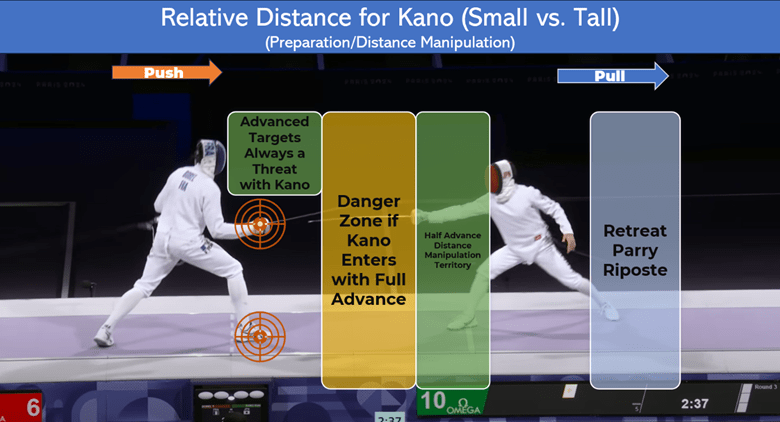
Small Against Tall: Strategies for a Gimli Sized Fencer
Let us assume there is a wee bitty Fencer named Gimli facing up against a giant named “Titan.” Gimli has the potential to be bullied if he allows Titan to push, impose pressure, and use his massive reach and length on the poor little dwarf. We can thus assume that Gimli’s Zufechten, Krieg, and Distance Given are smaller than those of Titan:

If you’re a pint-sized fencer like Gimli, the first truth you must accept is that you can control your distance, but you can’t control your height.
Observationally, successful fencers on the shorter side tend to be higher on the multi-tempo percentage (usually requiring an extra advance to enter and close distance), lethal on the short targets, and have a higher percentage of parry ripostes. While there isn’t a monolithic manner in which shorter fencers operate against larger fencers, what I generally saw were a few tactical common denominators.
- They tend to move with a much higher frequency and foot tempo.
- They work the short targets (flicks to the hand, toe touches) in a way that always establishes those areas as viable threats.
- They can enter and exit distance quickly enough to minimize the risk of attack in prep.
- They’re extremely strong on blade in the preparation, particularly with disruptive beats and engagements.
- They’re equally strong on blade in the closing action. Second intention is a large part of the shorter fencer’s game, threatening the short targets on the big boys, drawing out their attack, and finding parry-riposte with recovery and retreat.
Among some of the small fencers in my data set, I pulled out the following data and thought it was interesting to see their multi-tempo, short target, and parry riposte %’s.
| Fencer | Height | Single Tempo % | Multi Tempo % | % of Short Target Actions | Parry Riposte % |
| Yuval Freilich | 5’6 | 39% | 47% | 12% | 22% |
| Andrea Santarelli | 5’9 | 38% | 51% | 13% | 29% |
| Ruslan Kurbanov | 5’7 | 35% | 50% | 16% | 28% |
| Patrick Jorgensen | 5’8 | 22% | 59% | 15% | 26% |
| Koki Kano | 5’6 | 52% | 34% | 24% | 13% |
| Nicholas Zhang | 5’7 | 41% | 55% | 27% | 18% |
| Sera Song | 5’4 | 65% | 24% | 11% | 7% |
| Young Mi Kang | 5’4 | 29% | 50% | 7% | 26% |
| Nelli Differt | 5’7 | 22% | 72% | 16% | 17% |
Let’s give a few tactical examples here. This one, from the 2024 Paris Olympic Men’s Epee Final between Koki Kano (JPN) and Yannick Borel (FRA).
Kano’s tactic here is to pull (absorb the pressure), draw out Borel’s attack, and respond:

Because Kano is such a threat to the short targets, he effectively makes a feint under Borel’s hand.
Kano has done two things successfully here:
- He has manipulated the distance in such a way that Borel believes he can go
- He’s presented bait in the form of a feint that Borel believes he can take in Octave.

So the final choice is to recover from the deep half advance, take a deep 4, and riposte.
Another example from the 2022 Cairo World Championships Gold Medal Bout between Sera Song (KOR) and Alexandra Ndolo (now representing KEN).
Here’s an example of Song entering distance and attacking. Song stands at 5’4 against Ndolo who is about 6’2. Song is an acrobatic freak and is capable of making deep half advances which she rapidly recovers from. Her lunge can cover close to 2 meters, making her opponents often underestimate their relative distance to her. Her leg, hand, and toe touches are viable threats always, and she is arguably the most masterful on-blade French grip fencer on the international scene.

As Song pushes Ndolo, each time she threatens with a feint + half advance, Ndolo has a panic reaction to take 6 and retreat. Song feels this and senses blood in the water.

These full retreats and window created by Ndolo picking her tip up in 6 allow Song to come forward with a full advance on her first tempo, picking her tip up high on the feint…

And the final action is to do a deep lunge to the leg that covers just under 2 meters!

Tall Against Small
On the flipside, you have Titan’s perspective fencing against Gimli. Presumably, Titan has more space to prepare, more space to enter distance, and can also cede more distance to Gimli:

For the both of them, it looks something like this:

Tall fencers like Titan ought to be bullies, taking advantage of their length and wingspan to bulldoze their opponents backwards, limit their spacing, and finish strong with attack or draw them out and use the reach to keep them at bay with a counter.
Like the shorter fencers in my data who had a strong tendency to swarm the short targets and high parry-riposte %, with the taller fencers in my set, there was a propensity to finish with lunge and counterattack. And with the exception of Sergey Bida, who plays an imposing multi-tempo on blade game (with strong second intention/short actions), most of the taller fencers I studied had a certain mold:
- Most tend to move with a much lower frequency and foot tempo (Bida and Borel the exception).
- They use their long arms to pressure, draw the opponent out and counter, and disrupt the prep to keep opponents away.
- They don’t shy away from using their long legs and arms to hit with lunge (usually in single tempo with opposition).
- They use the speed and momentum of their shorter opponents against them to punish on sudden entrance into their distance.
| Fencer | Height | Single Tempo % | Multi Tempo % | Lunge% | Counterattack % |
| Yannick Borel | 6’6 | 64% | 27% | 23% | 27% |
| John Edison-Rodriguez | 6’8 | 68% | 20% | 43% | 25% |
| Jacob Jurka | 6’6 | 62% | 23% | 26% | 15% |
| Sergei Bida | 6’6 | 44% | 48% | 19% | 13% |
| Alexandra Louis-Marie | 6’1 | 56% | 34% | 26% | 10% |
| Katrina Lehis | 6’1 | 71% | 20% | 25% | 37% |
| Vivian Kong | 5’11 | 52% | 32% | 39% | 14% |
| Marie Florence Candassamy | 6’1 | 76% | 22% | 35% | 20% |
Now, an example of tall vs. Small:


Takeaways:
To be a Modern Epee Fencer requires keen awareness and understanding of your preparatory safe space, your single tempo attack distance, and the space you give to your opponent to create opportunities for yourself.
Without a strong half advance and half retreat game, it is difficult in the current meta to properly manipulate distance and deceive one’s opponent into entering your distance or provoking an attack with the proper distance and timing.
[1]“Rules and Referees” by Jeff Bukantz. Published in American Fencing magazine.
[1] https://www.americanfencer.org/fencing-features/the-best-15-changes-to-fencing-in-the-last-40-years
[1] https://hroarr.com/article/meyers-four-types-of-fencers-how-we-conceive-of-them-and-ourselves/