

Disclaimer: I was provided with a complimentary pair of the Octav fencing shoes in return for my honest review. I received no monetary compensation for this review, nor am I endorsed by Octav in any capacity. All thoughts and opinions expressed herein are my own and not influenced by Octav and/or its affiliates in any way.
Over the past few years, premium fencing shoes have started to feel like they’re actually designed around fencing instead of being “court shoes with a fencing label,” or in the case of the Nike Ballestras, “aesthetically pleasing turds with a fencing label.” When a design team understands what the movements of fencing entail: repeated lunges, hard retreats, awkward off-angle landings, and constant stop-start load, you see it in the details: how the tread locks in, how the shoe releases on pivots, where the outsole grips, and what gets reinforced (or doesn’t).
We saw that shift clearly with the Azzas, which were built by an Olympian sabre fencer and, for a lot of people, the first shoe that made the older mainstream options feel behind the curve. Then PBT came in with the Fenceras as a credible premium alternative, especially for fencers whose en garde and movement patterns don’t fit the “one-size-fits-all” geometry most fencing shoes assume.
And now we have the Octavs, a new UK-based company entering a market that finally has real competition at the top end. The question isn’t whether they look good (they do), it’s whether they perform where fencing shoes earn their keep: traction that’s reliable under braking and re-acceleration, stability in lateral corrections, impact protection when you’re completing an attack, and build quality in the spots that tend to fail first. That’s what I focused on in this review: what the Octavs do exceptionally well, where the tradeoffs show up, and who they’re actually a good fit for.
Design/Aesthetic
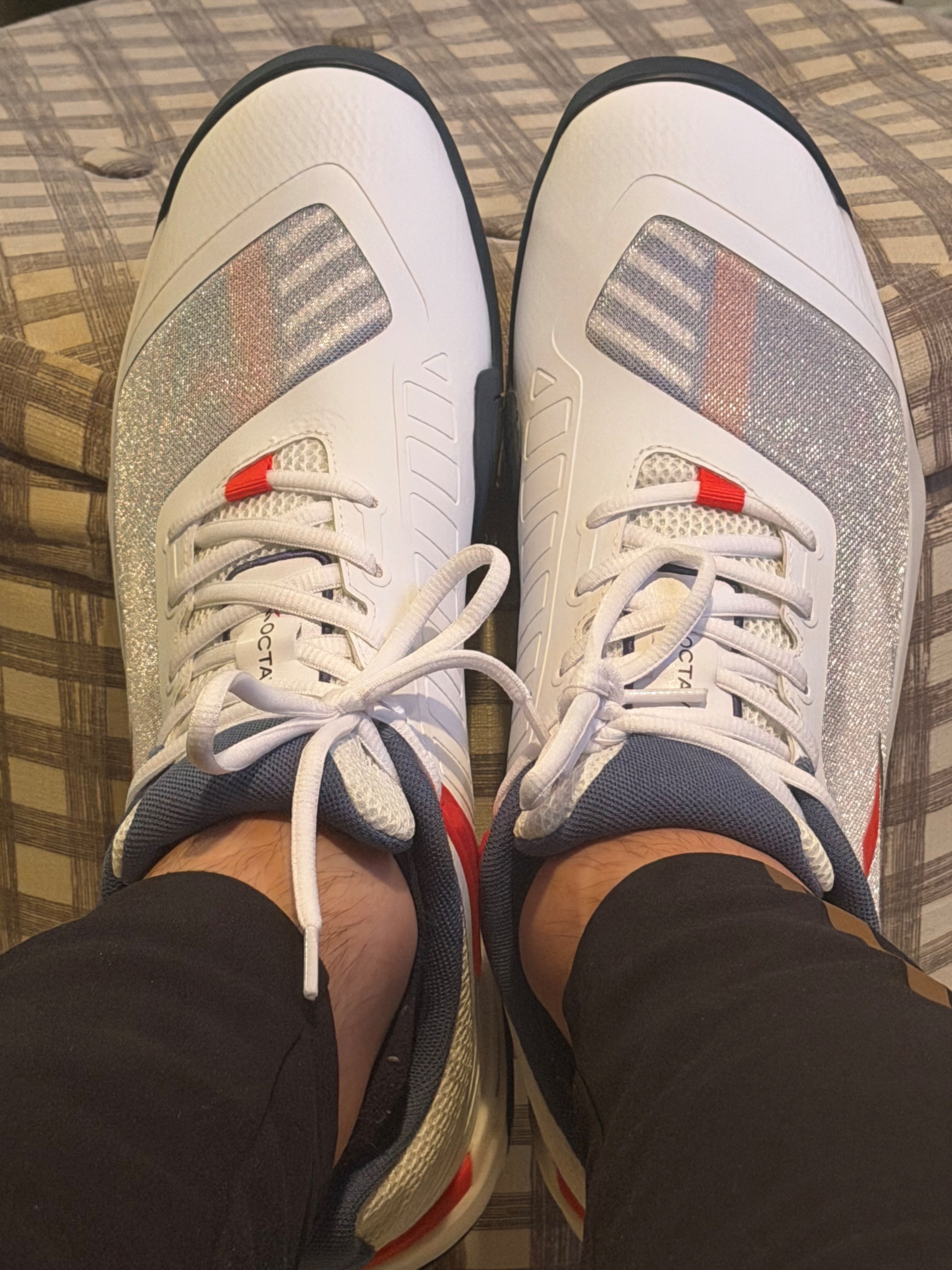
The Octav’s have two offerings at this time: a navy blue and red pattern that looks like something straight off the Tommy Hilfiger line, and a simple orange variation. I went with the “Hilfiger” version.
Design-wise, they present a clean, modern athletic aesthetic that balances design with broader athletic shoe trends. They’re sleek enough and subdued in color that I could wear these to the office on a business casual day.
The upper construction showcases an interesting mix of materials: a textured mesh panel dominates the midfoot area, providing visual interest through its semi-transparent gray weave that reveals underlying structure. This is framed by smooth synthetic leather overlays in white that create clean lines and defined zones across the shoe. The toe box features subtle linear striping details that add dimension without overwhelming the design.
The branding is tastefully executed with “OCTAV” displayed prominently on the lateral side in a modern sans serif looking font (unlike the comic sans lemonade stand nonsense on the Nike Ballestras). The tongue features a navy blue trim that coordinates with the collar lining for visual continuity.
The sole design is solidly navy blue with a red stripe running through the arch. The outsole displays an intricate geometric pattern with concentric circle and linear elements that provide a mix of grip technology and visual sophistication.
Overall these are shoes that look purposeful without being overly loud. They work equally well in competitive bout or casual athletic wear context. I’ve been wearing them to the office too, and they look natural even in a business casual environment. Plus, sometimes I do footwork in empty offices.
Function
It took me a few hours of wearing the Octav Fencing shoes before I shot a message to their owners and asked: “are you guys mainly foilists?”
They responded that I was “…about 70% right.”
A few things immediately jumped out to me regarding the Octavs in wearing them: they provide excellent heel/ankle support (after breaking them in), but they don’t have the same kind of pillowy cushioning for bouncing style fencers which is mainly an epee specific characteristic. And while I love the aesthetic of the meshing on the vamp, it’s the kind of material that feels like it’s a few firm toe shots away from ripping. For bouncing or “floating” footwork common in modern epee, however, these shoes feel less ideal. The firmer midsole construction and lower heel cushioning mean each landing has slightly more impact feedback. This isn’t necessarily a negative, as some fencers prefer ground feel—but it’s a notable characteristic compared to shoes specifically designed with maximum cushioning in mind. For that reason, I believe these shoes are fit for purpose primarily for right of way fencers who don’t always need the bouncy cushioning and toe protection.
Where these shoes truly shine is in the explosive movements that define modern right-of-way fencing. Advance-lunging felt crisp and controlled, and their lightweight construction was noticeable after a long practice. The low-to-ground profile of the Octav shoes encourages proper fencing mechanics. Unlike shoes with higher heel elevation, these keep you in an en garde position naturally. The flexibility in the toe box allows for proper weight transfer from heel to ball of foot during advances and retreats, while the midfoot stability prevents any twisting or rolling during directional changes.
These shoes feel best suited for the fencer who keeps their feet on the ground/on the balls of their feet without them leaving the ground. The Duron Tech rubber grips to the piste extremely well, and the signature NitroImpact foam on the shoe provides strong impact protection on an explosive lunge. When it came to sudden changes of direction and lateral movements on the piste, they gripped extremely well and I experienced no slippage.
For me, the Octav shoes took a few practices and a lot of adjustment on the laces to really break in. When wearing a fencing shoe, I want to feel snugness mostly around the ankle and heel. Out of the box, I felt a little more pressure around the shoe’s throat/eyestay, but once the synthetic leather of the shoe loosened a bit and I found the right balance in the lacing, I got the ankle/heel support I needed. The initial stiffness isn’t a dealbreaker. It’s actually a sign of quality construction that needs to conform to your specific foots shape. By the third or fourth practice, the shoes had molded to my feet considerably, and the heel counter had softened just enough to provide lockdown without creating pressure points. I experimented with different lacing patterns and found that skipping the second eyelet from the top gave me the best combination of security and comfort.
Like any shoe, I always recommend trying them on, asking a teammate to loan them for a bout or two, and testing the shoes based on your personal preferences, but I can confidently state these are fit for purpose for fencing movements and are premium-build quality—with one exception. Roughly one month into usage, the lunge protection part of the shoe on the back foot began to separate from the medial heel counter. After nuking it with gorilla glue, it was back to normal and hasn’t had any issues since, but it’s something to keep track of.
The shoes include removable insoles, which in my opinion is a “need to have” in any fencing shoe. I found the out of the box insoles were adequate, but it predictably provided a far more comfortable wear when I slipped in my customs.
Where these shoes distinguish themselves from their competitors is two-fold: for one, they’re helluh light. Weighing in at 13.3 oz per shoe, that puts them nearly 2 oz lighter than the Fenceras and 1.3 oz lighter than the Azzas (while somehow being .8 oz lighter than the Ballestra 2’s which look smaller?). That weight differential may not seem like a lot, but on a long competition day where you’re putting in tens of thousands of steps, the weight makes a difference.
The other area is in the tread itself. The Octavs use a geometric grid pattern with mostly straight lines and right angles across the contact zones. In practice, that grid behaves like lots of small, squared “edges” engaging the floor, which gives you confident traction in multiple directions, not just forward/back. That matters in this sport because you’re constantly asking the shoe to do contradictory things: grip hard for the initial push, then not fight you when you micro-adjust or rotate your foot a few degrees to find distance. With the Octavs, acceleration feels immediate, and braking on aggressive retreats feels controlled rather than skiddy. The grip is also uniform across the footprint, so no weird dead spots. The shoe feels the same whether you’re on the ball of the foot, midfoot, or catching slightly off-angle. This is hands down the best tread I’ve felt on a fencing shoe and it’s raised the bar.

All in all, it’s a shoe I like with some minor caveats. It’s one I recommend stress testing before buying, and I suspect it will become a preferred shoe among right of way fencers in particular.
A Brief Comparison of the Premium Fencing Shoes
| Functional Area | Octav | PBT Fencera | Azza 15/14 | Nike Balestra 2 |
| Weight | 13.3 oz | 15.2 oz | 14.6 oz | 14.1 oz |
| Width | Plenty of room for wider foot fencers. | More amenable to wider feet | Better suited for narrower feet | Good for placing on a mannequin doll and leaving them there forever |
| Flexibility | Flexible toe box—best for traditional style RoW fencers who keep their feet on the ground | Flexible toe box—best for those who keep a 45-degree angle en garde/stay on the balls of their feet | More rigid toe box, best for fencers who keep an orthodox 90-degree en garde | Flexible enough to fit in a full garbage can |
| Lunge Protection | Thick layer of DuronTech, but needed to be gorilla glued after a month of usage | Thinner layer, more for fencers who don’t drag the back leg on the lunge | Thicker layer for the fencers who shred through shoes | Protect your lunges by not wearing them. |
| Tread | Thin, but excellent grip and the new bar for tread. | Slightly thicker, excellent grip | Slightly thinner, also excellent grip | Might as well fence barefoot and grind your feet on the piste |
| Heel | Medium elevation (1.5 inches), solid heel cushioning | Medium elevation (1.5 inches), solid heel cushioning | Higher elevation (2.25 inches), best in class heel cushioning | Like fencing in high heels |
| Design/Aesthetic | Two varieties (Navy Blue or Orange) | One variety (Blue and White) | Four Varieties | Ok they’re cool |
Pricing/Availability
At their price point, the Octav shoes position themselves competitively within the premium fencing shoe market. The Octavs retail at $175.76 (USD), which places them ever so slightly cheaper than some of the other premium varieties. At the time of publication, they could be ordered directly from Octav’s website and shipped to the United States for $47 based on my location, which is ~27% of the shoe’s value. However, I’m told that fencingclub.shop, a Seattle-based fencing retailer, will be carrying the shoes shortly.
The Octavs also top out at size EUR 44, leaving those with big feet in the dust.
| Shoe | Price |
| Octav | $176 (plus $47 shipping…) |
| PBT Fencera | $185 |
| Azza 15/14 | $199 |
| Nike Ballestra SE2 | $189 |
| Kempa Attack Pro | $199 |
| Rophoo Fencing Shoes | $99 |
| Adidas D’Artagnan V | $170 |
| Adidas Solecourt Tennis Shoes | $160 |
| Adidas Barricade Court Tennis Shoes | $125 |
Verdict
The Octav fencing shoes represent a thoughtful entry into the premium fencing shoe market that clearly understands their target audience. They’re purpose-built for right-of-way fencers who prioritize lightweight construction, excellent grip, and clean aesthetics over maximum cushioning and bombproof toe protection.
After about two months of regular usage (3-4 sessions per week), the Octav shoes have held up reasonably well with one notable exception: the lunge protection rubber required gorilla glue reinforcement after about four weeks of use. This isn’t entirely unexpected for any fencing shoe, particularly for someone who lunges with frequency and force, but it’s worth noting for potential buyers.
I’d recommend these shoes to foilists and sabre fencers who maintain traditional footwork, competitive fencers seeking weight optimization, and anyone who values grip and lateral movement support over maximum cushioning. They’re a solid addition to the premium fencing shoe market and demonstrate that the sport continues to benefit from having active fencers involved in equipment design.

You must be logged in to post a comment.